.png)
What Accounting and Tax Deadlines Do I need to be aware of?

Tax deadlines sneak up on busy founders and small business owners every year. Staying ahead of them isn’t just about avoiding penalties; it protects cash flow, keeps investors confident, and lets you stay focused on growth.
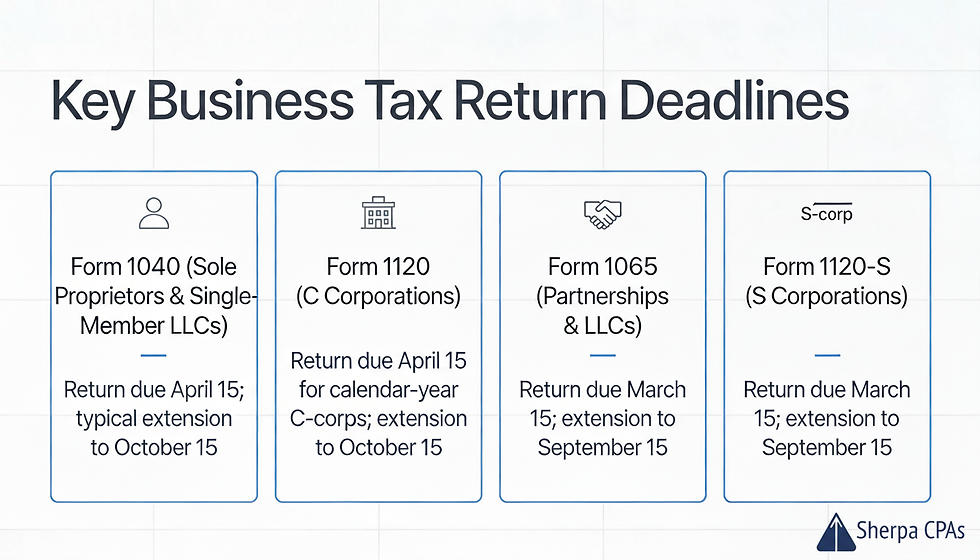
Key federal tax deadlines for startups and small businesses
For most calendar‑year businesses, these are the main income tax filing dates to watch.
Form 1040 for sole proprietors and single‑member LLCs is generally due April 15, with a typical extension to October 15.
Form 1120 for C corporations is usually due April 15 for calendar‑year C‑corps, with extensions available to October 15.
Form 1065 for partnerships and LLCs taxed as partnerships is typically due March 15, with extensions to September 15.
Form 1120‑S for S corporations is usually due March 15, also commonly extended to September 15.
An extension gives you more time to file, not more time to pay, so tax planning and cash planning need to happen well before these dates.
Quarterly estimated tax and payroll dates
If your business is profitable or you receive significant non‑W‑2 income, quarterly estimated tax payments become part of the routine. Once you hire employees, recurring payroll filings are added to your compliance list.
Typical federal estimated tax dates for calendar‑year taxpayers include April 15 for first quarter estimates, June 15 for second quarter, September 15 for third quarter, and January 15 of the following year for the final individual estimate.
Common payroll and information return dates include Forms W‑2 due to employees and filed with Social Security in late January, Forms 1099‑NEC to contractors generally due January 31, Form 941 quarterly payroll tax returns due at the end of the month following each quarter, and Form 940 annual federal unemployment tax returns typically due January 31. States also add their own sales tax, payroll, and annual report deadlines, which vary by jurisdiction.
Turn deadlines into a simple system
The easiest way to stay compliant is to treat deadlines as part of your operating rhythm instead of emergencies.
Create a 12‑month compliance calendar that lists every required return, due date, and owner. Set internal target dates at least one to two weeks before the official deadline so you have time to review books and resolve questions. Close your books monthly so tax returns, investor decks, bank applications, and board updates all pull from clean financial statements. Revisit projections mid‑year and again in the fourth quarter to fine‑tune estimated tax payments and avoid surprises.
How SherpaCPAs can help
SherpaCPAs works with startups and medium-sized businesses to build and maintain that tax and accounting calendar for you. We are your fully outsourced accounting department that can handle year‑round bookkeeping, payroll coordination, and proactive business tax planning, so every IRS deadline is tracked, prepared, and filed on time. If you want a dedicated CPA team that keeps you compliant while you focus on scaling your company, SherpaCPAs can serve as your outsourced accounting and tax department.
This material is for general informational purposes only and does not constitute tax, legal, or accounting advice. You should consult your own CPA or tax advisor regarding your specific situation before taking any action.


Comments